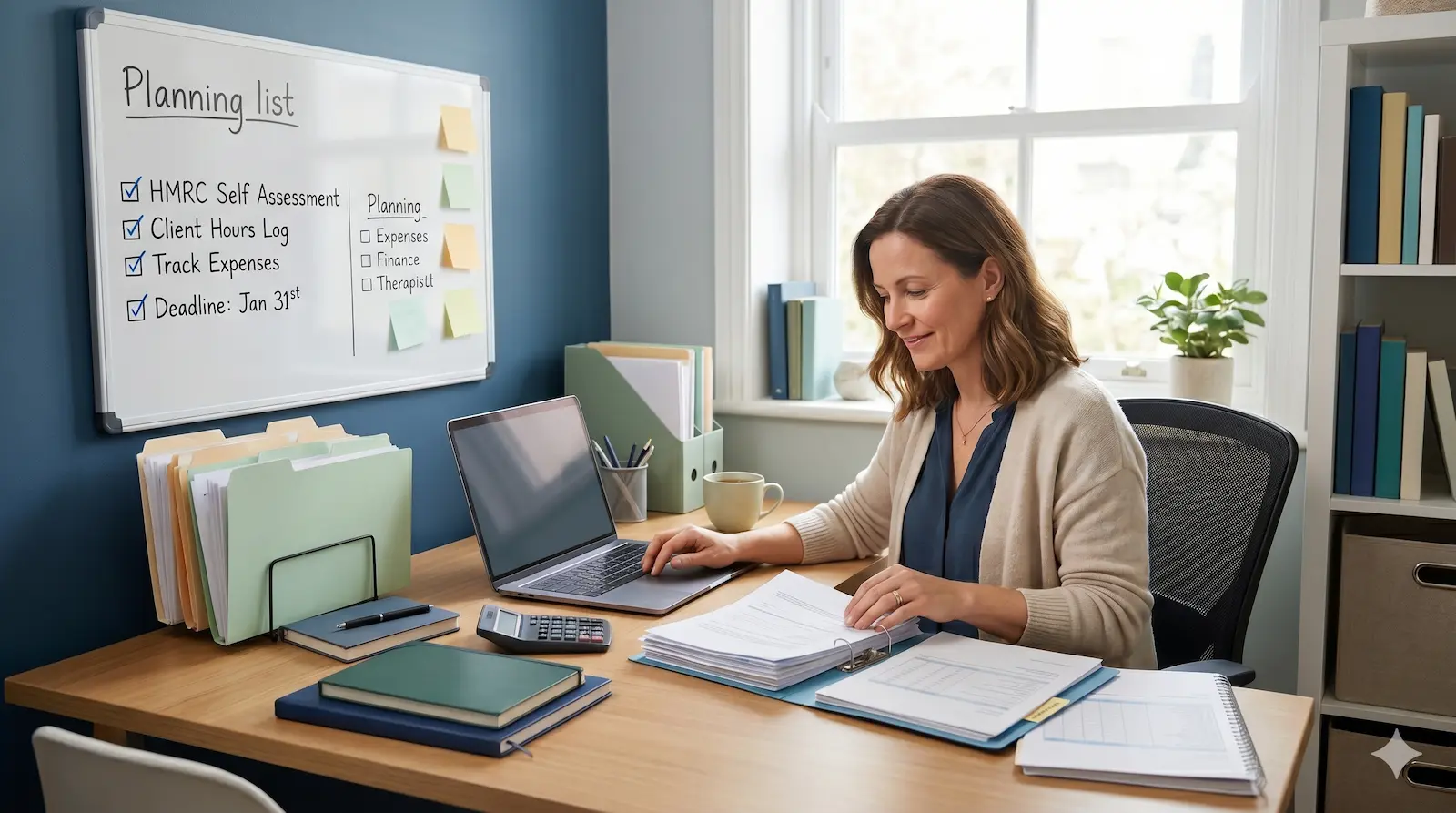
HMRC Self-Assessment for Therapists: managing your finances so you're ready
28 April 2026

For many therapists, finances sit in that awkward category of “important, but easy to avoid until they become urgent”.
Most of us came into this profession to work with people, not to spend evenings sorting receipts, checking bank statements, or trying to remember whether that supervision fee counts as a business expense.
But if you are in private practice, getting your finances in order early makes a huge difference. It reduces stress, helps you understand whether your practice is actually sustainable, and means tax returns stop feeling like a yearly panic.
The good news is that it does not need to be overly complicated. You just need a simple system and a basic understanding of what HMRC expects.
Start with the right mindset: your finances are part of good practice
When you run a therapy practice, finances are not separate from the work. They affect your boundaries, your confidence, your pricing, and your stress levels.
If you do not know what is coming in, what is going out, or what you will owe in tax, it is very easy to feel constantly on edge. That can lead to undercharging, poor financial decisions, or the sinking feeling of getting to January and realising you are nowhere near ready.
HMRC requires sole traders to keep records of business income and expenses for Self Assessment. You also need to keep records of any personal income you include on your tax return. Those records generally need to be kept for at least 5 years after the 31 January submission deadline for the relevant tax year.
So even before we get to the tax return itself, the foundation is simple: track your income properly, track your expenses properly, and keep records as you go.
Do you need to register?
If you are working for yourself, even part-time alongside employed work, you may need to register for Self Assessment as self-employed.
HMRC's current guidance says that if your total receipts from self-employment and miscellaneous income are over £1,000 (as of the 2025/26 tax year), you generally need to complete the self-employment pages of your tax return unless the trading allowance fully covers you and you choose to claim it instead. HMRC also says that if you are new to Self Assessment, you normally need to tell them by 5 October following the end of the tax year in which you started trading.
For most therapists in private practice, that means not leaving registration until the last minute.
What records should therapists keep?
This is the area that helps most when done consistently.
HMRC says self-employed people must keep records of:
- all business income
- all business expenses
- VAT records, if registered
- PAYE records, if employing staff
- and supporting paperwork such as receipts, invoices, till rolls and bank statements where relevant.
For therapists, that usually means keeping a clear record of:
- client payments received
- invoices issued
- room rental payments
- supervision costs
- insurance payments
- professional membership fees
- training and CPD costs where allowable
- software subscriptions
- website and marketing costs
- stationery, phone and admin costs
- mileage or travel for allowable business journeys
A separate business bank account is not legally required for every sole trader, but in practice it makes life much easier. It gives you a cleaner record of what belongs to the practice and what belongs to personal life.
What can you claim as an expense?
HMRC's general rule is that you can claim allowable expenses that are wholly and exclusively for the purposes of the business. Its self-employed expenses guidance lists categories such as office costs, travel costs, financial costs, costs of business premises, advertising or marketing, and training courses related to your business.
For therapists, commonly claimable business expenses may include:
Room hire or premises costs
If you rent a therapy room, that is usually a straightforward business expense. If you work from home, you may be able to claim a business proportion of household costs or use simplified expenses, depending on how you work and what HMRC allows for self-employed home use. HMRC's self-employed expenses guidance covers this.
Insurance
Professional indemnity and public liability insurance are usually business expenses where they relate to your practice. HMRC includes insurance within allowable financial costs where it is for the business.
Professional memberships and subscriptions
Relevant professional memberships and subscriptions can often be claimed where they are for the business. For employees, HMRC separately confirms tax relief may be available for fees to approved professional bodies where relevant to the job, and for self-employed therapists these would typically fall into business expenses where they are incurred for the practice.
Supervision
For most therapists, supervision is a core cost of practising safely and ethically. In most cases it is treated as a business expense because it is directly related to the work.
CPD and training
HMRC allows training courses related to your business as part of self-employed allowable expenses guidance, though the line can become less straightforward if training is more about entering a new field than maintaining or updating your current practice.
Software and admin tools
Practice management software, secure note systems, scheduling tools, accounting software, video platforms, website hosting and domain costs are all often legitimate business expenses if used for the practice.
Marketing and website costs
Advertising and marketing costs are included in HMRC's self-employed expenses guidance. For therapists, this may include directory listings, website costs, business cards or paid ads if you use them.
Travel
HMRC allows business travel costs such as fuel, parking, train or bus fares for allowable business journeys. Ordinary commuting is not generally allowable, but travel for business visits may be.
Expenses therapists often get wrong
This is where it helps to be cautious.
Just because something supports your wellbeing or your career in a broad sense does not automatically make it an allowable business expense. The test is whether it is genuinely and exclusively for the business.
Areas that often need extra care include:
- clothing, unless it is a true uniform or protective clothing
- mixed personal and business phone or broadband use
- home costs where there is personal as well as business use
- training that is really about starting a new trade or specialism rather than maintaining your existing one
- personal therapy, which many therapists see as essential professionally, but which is not automatically treated by HMRC as a straightforward allowable expense
That is one reason many therapists find a short conversation with an accountant so helpful.
Should you do Self Assessment yourself or use an accountant?
This is not really a right-or-wrong question. It is a “what fits your situation?” question.
Self-submitting may suit you if:
- your practice is fairly simple
- you are a sole trader
- you are comfortable with spreadsheets or bookkeeping software
- you keep your records tidy throughout the year
- you do not mind learning the system
An accountant may be worth it if:
- you have mixed income streams
- you are also employed
- you run an agency or use associates
- you are VAT-registered
- you feel anxious about tax
- you know you are likely to procrastinate and would rather have support
Many therapists start by self-submitting and then move to an accountant once the practice grows. Others use an accountant from the beginning simply for peace of mind.
The key point is this: an accountant can only help properly if your records are reasonably organised. Handing over a year of vague bank transactions and hoping for magic is rarely the cheapest or calmest route.
Make tax less stressful with a simple monthly routine
The best financial systems are usually not complicated. They are just consistent.
A simple monthly process might look like this:
- check all client payments received
- log all expenses
- save or photograph receipts
- make sure invoices match payments
- put aside money for tax
- review whether your fees and outgoings still make sense
This is especially important now because HMRC is gradually moving sole traders and landlords toward Making Tax Digital for Income Tax. The first phase from April 2026 affects those with self-employment or property income above £50,000; later thresholds will phase in over the following years. Even if you are below the threshold, getting into good digital record-keeping habits now puts you in a stronger position for when the rules eventually apply to you.
Good financial records support better boundaries
This is the part people often underestimate.
When your finances are unclear, everything feels heavier. You hesitate over fees. You avoid looking at your numbers. You feel vague about what you can afford. You put off decisions. And all of that mental clutter comes back into the room with you.
A simple, reliable system helps you feel more contained as a practitioner. You know what is coming in, what needs paying, what to save for tax, and where your practice actually stands.
That clarity is not cold or overly business-like. It is part of running a sustainable practice.
And that is one of the reasons we built Sessionly. Alongside the clinical side of private practice, therapists also need practical systems that help them stay organised, keep records tidy, and reduce the admin stress that so often builds in the background.
This blog post is for general guidance only and does not constitute tax or legal advice. Tax rules change. For your specific circumstances, speak to a qualified accountant or tax adviser, or check current guidance directly at gov.uk.
See how Sessionly helps UK therapists track income, expenses and HMRC self-assessment categories.
See accounting software for therapists →Or read about Sessionly's billing and invoicing.