Why we built Sessionly
10 April 2026

If you have ever sat at your laptop after a full day of client work and thought, "I trained to be a therapist, not an administrator", you are not alone.
That sentence, in one form or another, is exactly what led to Sessionly.
This was not a "spot a market gap and build some software" story. It was much closer to home than that. Sessionly was born from watching my wife run her own therapy practice and then grow an ecotherapy agency in the UK — and seeing, up close, just how much emotional and practical strain sits behind the scenes of good therapeutic work.
Therapy work is deeply human. The admin often is not.
From the outside, private practice can look simple enough. A therapist sees clients, keeps notes, manages a diary, sends invoices, replies to enquiries, and keeps everything ethically and legally sound.
In reality, it rarely feels that tidy.
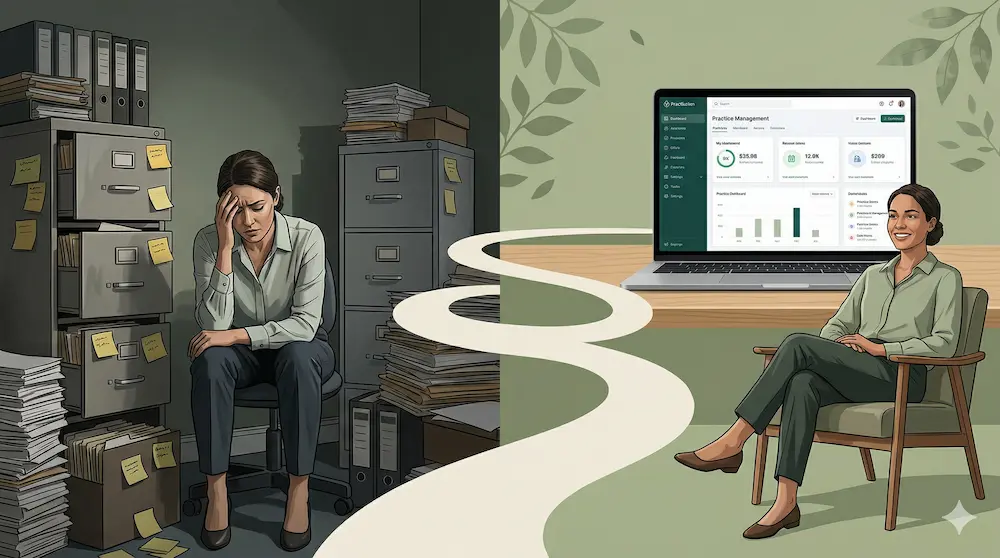
As my wife's practice grew, so did the invisible workload around it. There were notes to write (and keep securely), enquiries to respond to, assessments to do, policies and procedures to write or update, boundaries to hold, and the ongoing question every therapist knows well: "How do I stay present for clients when the admin is pulling me in ten different directions?"
And once the work expanded into an agency model, the complexity multiplied.
It was no longer just about one diary or one set of notes. It became about supporting multiple therapists, keeping systems consistent, reducing risk, protecting confidentiality, and making sure nothing important slipped through the cracks. That pressure is real, especially in a profession where clients are trusting you with some of the most sensitive parts of their lives.
For UK therapists, this is not just about convenience. Good admin supports good practice. BACP's private practice resources and Good Practice in Action materials place clear emphasis on the importance of contracts, confidentiality, record keeping, and ethical practice management in private work.
The challenge was the accumulation of small things.
Hundreds of tiny tasks that all seem manageable on their own.
For my wife, the emotional labour of the work was never the problem. She loves the therapeutic work. She cares deeply about clients. She cares deeply about the therapists in her agency too.
The problem was that the software available often felt either too generic, too clinical, too American, too clunky, or simply not designed for the actual rhythm of UK private practice.
Some tools handled appointments. Some handled notes. Some handled forms. Some handled websites. But very few seemed to understand the whole picture of what it is like to run a therapy practice or a small therapy agency here in the UK. What we needed was genuine therapy practice management software — and it did not exist.
And that matters.
Because when your systems are fragmented, your head stays fragmented too.
Therapists need software that respects the way therapy actually works
One of the biggest frustrations we kept coming back to was this: therapists should not have to force their practice to fit software that was clearly built for someone else.
Therapy is not just "another service business".
It involves confidentiality, sensitive data, careful boundaries, clinical responsibility, and clear ethical record keeping. In the UK, therapists also need to think carefully about UK GDPR responsibilities, privacy notices, secure storage, data minimisation, retention, and appropriate security measures.
In other words, therapists do not just need "business software". They need systems that support the realities of ethical practice.
That is the lens through which Sessionly was built.
Sessionly started with a very practical question
The question was simple: what would make life genuinely easier for a therapist or small agency owner without adding more noise?
Not more features for the sake of features. Not another bloated platform. Not a system that takes weeks to understand.
We wanted something that could support the real day-to-day of practice: for solo therapists, a place to manage core admin without losing hours every week to patching together multiple tools. For growing agencies, a way to keep things organised across therapists, clients, notes, workflows and admin processes without everything relying on one person's memory. For both, a system that felt designed around therapeutic work, not bolted awkwardly onto it.
That meant thinking carefully about the things that actually create strain in practice: storing notes securely, keeping records organised, managing enquiries and waiting lists, tracking assessments and outcomes, reducing back-and-forth admin, supporting better boundaries, and making it easier to run a professional service without spending every spare hour "doing the business side".
Boundaries were a huge part of the story
This is something I do not think gets talked about enough.
"When admin is messy, boundaries suffer."
Not because therapists do not care, but because mental load spills everywhere. You tell yourself you will reply later, you keep a note in your phone, you write something on paper, you mean to update a spreadsheet, you remember an important task at 9:30 at night.
Over time, the practice starts living in your head.
That is exhausting.
For my wife, one of the biggest drivers behind wanting a better system was not just efficiency. It was containment. She wanted a practice that felt held. A place where important information lived in the right place, where processes were clearer, and where the business did not constantly leak into evenings, weekends, and family life.
That is a very real need for therapists, especially those trying to scale from solo work into a small agency model.
We built Sessionly because the UK therapy space deserves better tools
There are plenty of software platforms out there. But many still miss the nuance of this profession.
They miss the reality that therapists are balancing care, ethics, compliance, and business ownership all at once.
They miss the fact that many practitioners are brilliant clinicians but do not want to become accidental operations managers just to keep their practice running.
They miss the very specific UK context too: the language therapists use here, the standards they work to, the expectations around confidentiality and notes, and the practical pressures of private practice.
Sessionly was built to respond to that gap.
Not from theory. From lived experience.
From watching a therapist and agency owner do meaningful work while carrying too much admin. From seeing how easily good people can become overextended by systems that do not support them properly. From believing that therapists deserve software that gives them back some headspace, helps them stay organised, and supports the kind of practice they actually want to run.
The heart of Sessionly
At its core, Sessionly is about reducing friction.
It is about making the running of a practice feel calmer, clearer, and more sustainable.
It is about helping therapists and small agencies spend less time wrestling with admin and more time focused on the work that matters.
And honestly, it is also about respect.
Respect for the profession. Respect for the complexity of therapeutic work. Respect for the fact that behind every "small private practice" is often one person holding an enormous amount.
That is why we built Sessionly.
Not because the world needed more software.
Because therapists needed better support.
Sessionly helps therapists manage their whole practice in one place — notes, clients, diary, invoices, outcome measures and more.
Try it free for 14 days