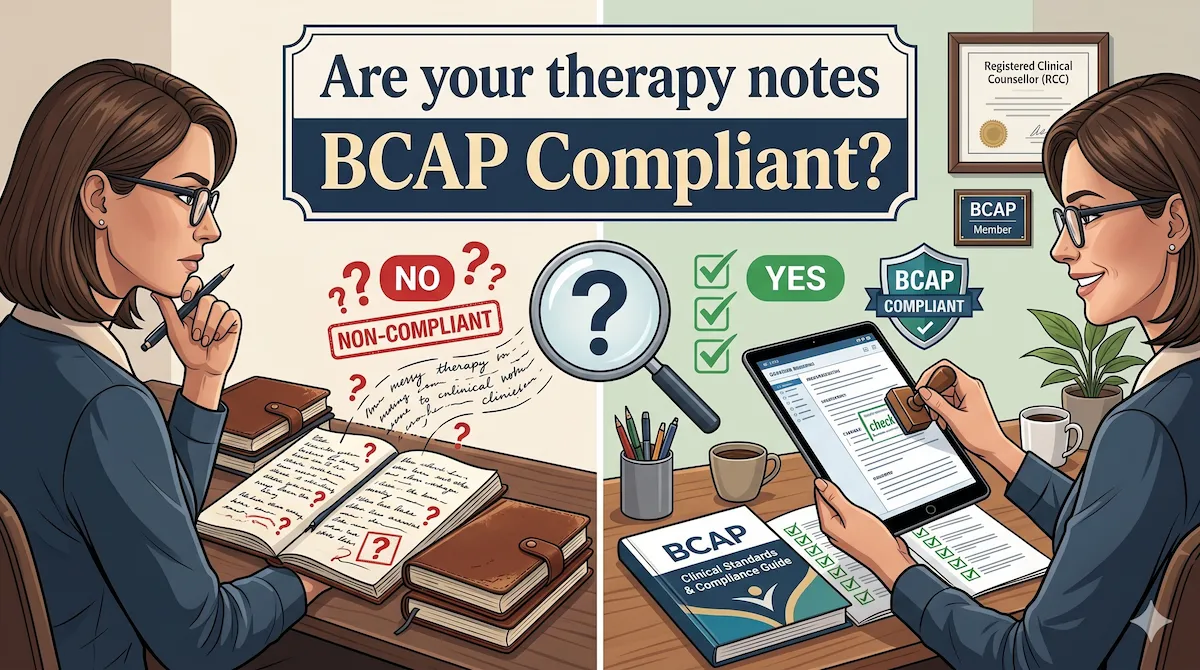
BACP Record Keeping Guidelines: Are your therapy notes compliant?
12 May 2026

Most therapists know that note taking matters.
What is less clear, especially in private practice, is what “good” or “compliant” record keeping actually looks like in day-to-day work. How much should you write? Where should you store it? Do clients have the right to see it? And what does BACP really expect?
If you are a BACP member, record keeping is not just an administrative choice. It sits inside your ethical responsibilities around confidentiality, client care and professional accountability. BACP's current guidance on confidentiality and record keeping is designed to help members think ethically and practically about how they create, store and manage records.
So the useful question is not just “Do I keep notes?” but: Are my therapy notes accurate, proportionate, secure and consistent with BACP guidance?
Does BACP require therapists to keep notes?
BACP's recent public guidance says there is no law that says therapists must always take notes, but there is usually an expectation that they will, and if a complaint arose a therapist may need to explain their decision-making around note taking.
In other words, while therapy notes are not a one-size-fits-all legal requirement in every possible situation, BACP clearly treats record keeping as part of responsible professional practice. That expectation is also reflected in BACP private practice materials and contract resources, which describe members as being expected to keep accurate and appropriate notes of the work and to store them securely.
So for most private practitioners, the safest practical answer is yes: you should usually be keeping some form of appropriate notes.
What makes therapy notes “compliant” in practice?
BACP's guidance does not reduce this to a rigid checklist, but several themes come through clearly.
1. Notes should be accurate and appropriate
BACP contract guidance refers to keeping accurate and appropriate notes of the work.
That usually means notes should be:
- clear enough to be useful
- relevant to the work
- proportionate, not excessive
- written in a way that reflects professional judgement
A session note is rarely meant to be a full transcript. In most cases, it should capture clinically relevant information without recording more sensitive detail than necessary.
2. Notes should support confidentiality
BACP's confidentiality guidance and complaint-learning resources emphasise that confidentiality is foundational to therapy and that client information needs to be handled carefully.
That includes thinking not just about what you write, but how you store it, who can access it, and whether identifying information is separated appropriately.
3. Clients should be told what happens to their data
BACP's GDPR guidance and privacy notice resources make clear that therapists should explain what information is collected, why it is held, how it is stored, and clients' rights in relation to it.
If your record-keeping process is not clearly explained in your privacy notice or contract, that is often an early sign that your notes system needs tightening up.
Common signs your notes may not be compliant enough
Many therapists are doing broadly sensible things, but their systems have grown a bit messier over time.
Here are some common warning signs:
- notes are stored across multiple places
- client names and notes are mixed together without any thought to minimisation
- there is no clear retention plan
- text messages, emails and forms are not treated as part of the record
- your privacy notice does not really match what you do in practice
- you are not confident what you would do if a client made a subject access request
None of these automatically means you are in serious breach. But they do suggest your record-keeping system may need reviewing.
What does BACP say about confidentiality and storage?
BACP's confidentiality and record-keeping resource is focused on ethical thinking rather than narrow technical rules, but the direction is clear: records must be handled in ways that protect client confidentiality and support safe practice.
BACP's privacy notice guide also highlights that therapists need to explain their lawful basis for holding personal data and the additional lawful basis for processing special category data under GDPR. Therapy notes will usually involve highly sensitive personal data, so record keeping is not just about convenience. It is also a data protection issue.
Do clients have the right to access therapy notes?
In many cases, yes.
BACP's recent notes and record-keeping blog specifically discusses clients' rights to access therapy notes, and BACP's broader GDPR guidance points members towards their responsibilities under UK GDPR and the Data Protection Act 2018.
That means notes should be written on the assumption that they may one day be read by the client, a supervisor, a regulator or, in some cases, a court. That does not mean writing defensively. It means writing professionally, respectfully and proportionately.
Are your notes proportionate?
This is one of the most important questions.
BACP's guidance is consistent with a proportionate approach. Notes need to be useful and ethically sound, but not excessive. A compliant record-keeping system is not the one with the most words. It is the one that records what is necessary, stores it securely, and makes sense in relation to your modality and client work.
In practice, proportionate notes often include:
- date and attendance
- key presenting issues or themes
- significant risk or safeguarding matters
- important decisions or interventions
- agreed follow-up or actions
They usually do not need to be exhaustive narratives of every session.
What should therapists review in their current note-taking process?
If you want a practical compliance check, start here:
Ask yourself:
- Are my notes accurate and clinically relevant?
- Are they stored securely?
- Is access controlled properly?
- Does my privacy notice explain my process clearly?
- Do I know how long I keep records for?
- Do my contracts and admin systems match what I actually do?
- Would I feel reasonably comfortable if a client requested access to their notes?
If several of those answers are “not really”, it may be time to review your notes system.
Why your notes system matters as much as the notes themselves
One of the biggest problems in private practice is not bad note writing. It is fragmented systems.
When session notes sit in one place, forms in another, emails elsewhere, and contact details somewhere else again, compliance becomes much harder to maintain. Even if each individual piece is sensible, the overall system becomes difficult to explain, secure and manage.
That is why your therapy notes setup matters so much. A compliant note-taking process is not just about what goes into the note. It is about how that note lives within the wider practice.
At Sessionly, we've built counselling notes software designed to help UK therapists keep notes accurate, secure and easier to manage within one clear workflow.
Sources
- BACP Ethical Framework for the Counselling Professions — bacp.co.uk
- ICO guide to the UK GDPR — ico.org.uk
- Data Protection Act 2018 — gov.uk
This blog post is for general guidance only and does not constitute legal, regulatory or professional advice. BACP guidance is updated over time. For your specific circumstances, refer to current BACP guidance directly or speak to your supervisor or professional body.
See how Sessionly helps UK therapists keep notes compliant, secure and easy to manage.
Visit our therapy notes page →