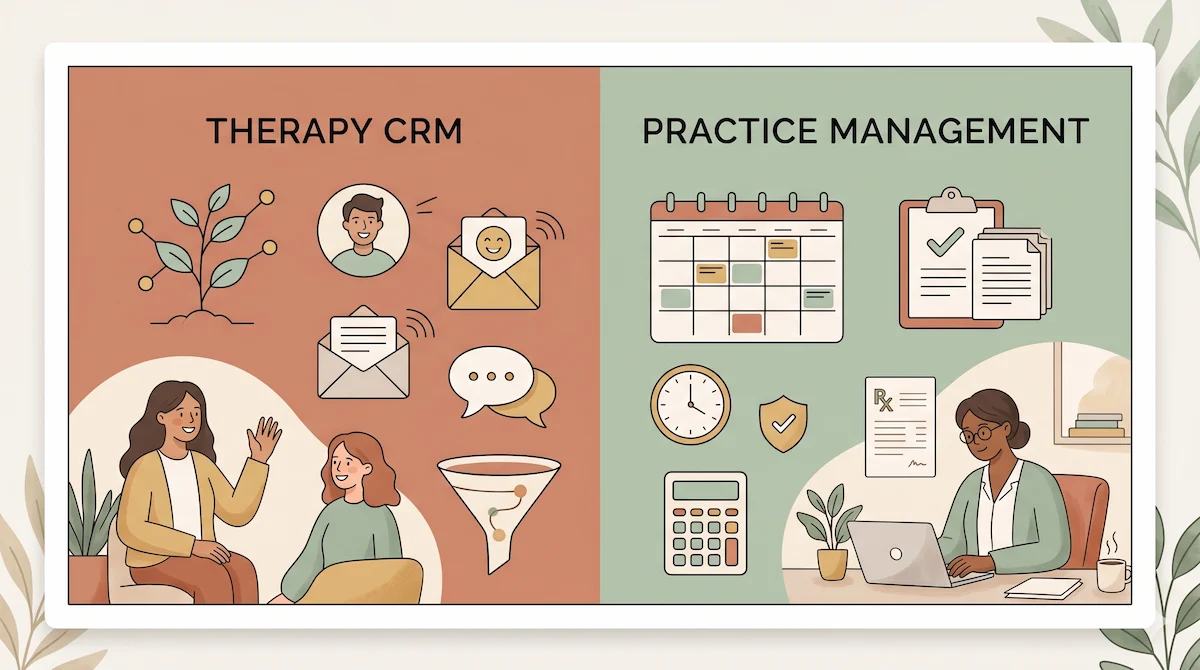
Therapy CRM vs practice management software: what UK therapists actually need
20 June 2026

If you've typed “therapy CRM” into Google in the last year, you're in good company. A lot of UK therapists are. The search results are a mix of generic sales CRMs trying to look therapy-shaped, a handful of US health platforms, and a smaller number of UK-built tools that call themselves practice management software rather than CRMs.
The naming is confusing, and the distinction matters. This piece walks through what each kind of tool is actually designed for, why generic CRMs fall down on therapy work, and what to look for if what you really want is a way to manage your practice as a whole — not just track contacts.
What a CRM is, in the original sense
CRM stands for customer relationship management. The category was built for sales teams. The mental model is a pipeline: a lead comes in, gets qualified, becomes an opportunity, and either closes or doesn't. The job of the software is to track where each contact sits in that pipeline, remind you what to follow up on, and keep a history of every interaction.
Tools like HubSpot, Salesforce, Zoho and Pipedrive are the heavyweights here. They're excellent at what they do. Sales teams managing hundreds of deals at a time use them to make sure nothing falls through the cracks.
The instinct to apply this to a therapy practice is understandable. You also have a pipeline of sorts: people enquire, you assess them, some end up on a waiting list, others start ongoing work, some end therapy. The shape looks similar from a distance. And the day-to-day frustration is the same — too many people to keep track of in your head, too many touchpoints to remember.
Where the analogy breaks
The mental model that makes a sales CRM useful — lead, opportunity, closed — doesn't fit therapy work, for a few reasons that become obvious the moment you actually try.
Therapy relationships don't close. The endpoint of a sale is a signed contract and a paid invoice. Everything after that is “account management” in a separate part of the system, or nothing at all. The endpoint of a therapy relationship is an ending, which is itself clinical work that needs to be recorded and reflected on. The middle — the ongoing therapy — is the bulk of the work, not a post-script.
Records have to be clinical, not just commercial. A sales CRM stores notes, but they're commercial notes — “had a good call, sending the proposal Tuesday.” A therapy record needs to be structured for clinical purposes: session notes, process notes, outcome measure scores, risk flags, review summaries. None of that fits cleanly into a CRM's free-text notes field, and none of it carries the structure that BACP-aligned record keeping expects.
The regulatory environment is different in kind, not degree. UK therapists work under GDPR and professional body guidance on confidentiality, record retention, supervision, and CPD. A sales CRM treats your contact data as commercial data. It doesn't have a concept of clinical pseudonymisation, BACP-aligned 7-year retention, or the separation between administrative and clinical records that UK confidentiality conventions assume.
The money side is a different shape too. Sales CRMs talk about deal values and forecasts. Therapy practices talk about session-by-session invoicing, HMRC self-assessment categories, and — for agencies — funding pots, commissioner reporting and demographic returns. None of that is what a generic CRM is built for.
You can adapt a generic CRM to all of this if you're willing to bend it. Some therapists do. Most outgrow the workaround within a year.
What practice management software is
Practice management software is a broader category. It includes the relationship-tracking piece a CRM gives you — client records, contact history, journey stages — and then adds everything else a practice needs to operate: clinical notes, outcome measures, calendar and self-booking, invoicing, finance tracking, CPD logs, documents and signed agreements.
The simplest way to put it: a CRM tracks who your clients are and where they sit in your pipeline. Practice management software does that, plus everything else that touches a client — the clinical work, the money, the regulatory record-keeping.
For a UK therapist, the question isn't really “CRM or practice management?” It's “how much of my practice do I want one tool to handle?”
What to look for if you're evaluating either
Whether you're comparing CRMs or practice management tools, the same checklist holds. If a tool can't do these things cleanly, it's likely going to push the work into a spreadsheet within months.
- A visible client journey. You should be able to see at a glance who's in enquiry, who's being assessed, who's waiting, and who's active. Without this you lose capacity awareness, and waiting lists quietly stagnate.
- Proper clinical record structure. Session notes and process notes as distinct, structured records — not free-text fields. Templates that match how you actually write (SOAP, DAP, or free-form). A version history that gives you an audit trail.
- Outcome measures, scored automatically. PHQ-9, GAD-7, CORE-10, CORE-OM, YP-CORE, DES-II, WSAS and Goal-Based Outcomes are the measures UK therapists actually use. The tool should score them server-side, flag risk items per professional guidance, and chart progress over time.
- UK regulatory fit. GDPR-first design, UK or EU data hosting, AES-256 encryption at rest, BACP-aligned retention, CPD and supervision hour tracking aligned with professional body requirements.
- HMRC-compatible finance handling. Invoicing that auto-generates from your calendar, expense tracking by HMRC self-assessment category, and an export your accountant can actually use in January.
- A full communication audit. Every interaction with a client — sessions, notes, messages, file uploads — needs to be recorded with a timestamp. If a subject access request, professional body inquiry or supervision discussion ever calls for it, the record has to be there.
How Sessionly fits in
Sessionly is practice management software, not a CRM. But it does what a CRM does — client records, a visible client journey board, contact history, audit trail — and adds the clinical, regulatory and finance pieces a generic CRM doesn't.
If your search started with “therapy CRM” and what you were really looking for was a way to keep on top of your whole practice, the Sessionly therapy CRM page is a reasonable place to compare what you'd get against what a sales-built CRM would force you to work around.
If your search started with “practice management” and you're already comfortable with that framing, the practice management page covers the same ground from that angle.
A short summary
A CRM tracks relationships. Practice management software tracks relationships plus the clinical and regulatory work that comes with them. For a UK therapist, the second is almost always what you're looking for, even if you started typing the first.
If you'd like to see how it looks in practice, Sessionly has a 14-day free trial with no credit card required.
Mark Devereux is the founder and CTO of Sessionly, UK practice management software for therapists, counsellors, and counselling agencies. He builds Sessionly with his wife Kate Devereux, an NCPS-registered therapist who runs both a private counselling practice and Earth Wisdom Therapy CIC.
Try Sessionly free for 14 days. No credit card required.
Start your free trial →