Practice management software for UK counselling CICs

For counselling CICs and community counselling charities running a mix of funded, subsidised and commissioned therapy. Manage clients, funding pots, clinical governance and demographic reporting in one secure platform.

No credit card required. Up to 25 therapists. £49.99/month.

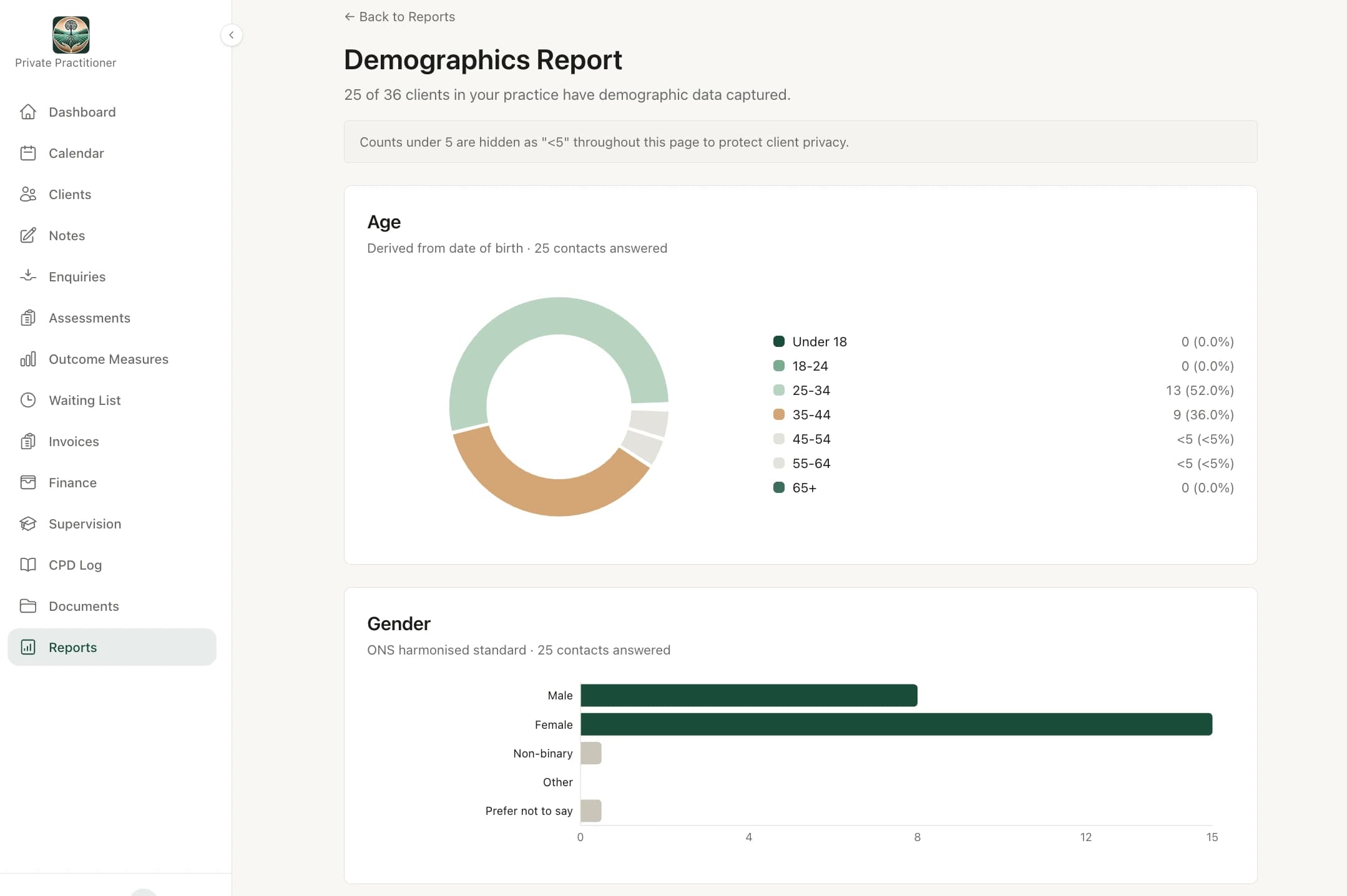
Sessionly demographic report filtered by funding pot, showing visual breakdowns of client demographics for a UK counselling CIC

Counselling CICsCommunity counselling charitiesCommissioned servicesGrant-funded programmesEAP block bookingsVolunteer & sessional counsellors

Provenance

Built with a UK counselling CIC, not designed at it

The funding, split-payment and demographic-reporting features did not come out of a whiteboard session. They were designed and built collaboratively with a UK counselling CIC running both commissioned services and grant-funded therapy programmes. Every part of the workflow — pot setup, client cost splitting, expense tagging against pots, filtered demographic reports — exists because a real CIC needed it and told us it was missing from the software they had before.

What that means in practice: the shape of a funding pot, the way a session gets split, the breakdown of a demographic report — none of it is guesswork. If your CIC is running the same kinds of grants, contracts and referrer blocks, the software is already shaped for the reality of that work.

Funding pot setup screen in Sessionly, showing pot name, amount, and date range fields for a UK counselling CIC

What running a counselling CIC actually looks like day-to-day

Most therapy practice management software is built for the private-pay model: one client, one therapist, one invoice. A counselling CIC does not work that way. A single client might be part-funded by a local authority contract, part-covered by a small grant, and part-paying on a sliding scale. A different client might be one of a block of ten sessions an EAP paid for up front. The bookkeeping across all of this — who paid for what, against which pot, for whom — is real administrative labour.

On top of that sits the reporting layer. Commissioners want to see who the money reached. Funders want the demographic picture of the people served. Referrers want to know how their block is going. Sessionly's job is to keep the underlying data continuously tidy, so the reports at the end of it come straight out of the software instead of a week of spreadsheet archaeology.

Funding pots

One pot per grant, contract or referrer block

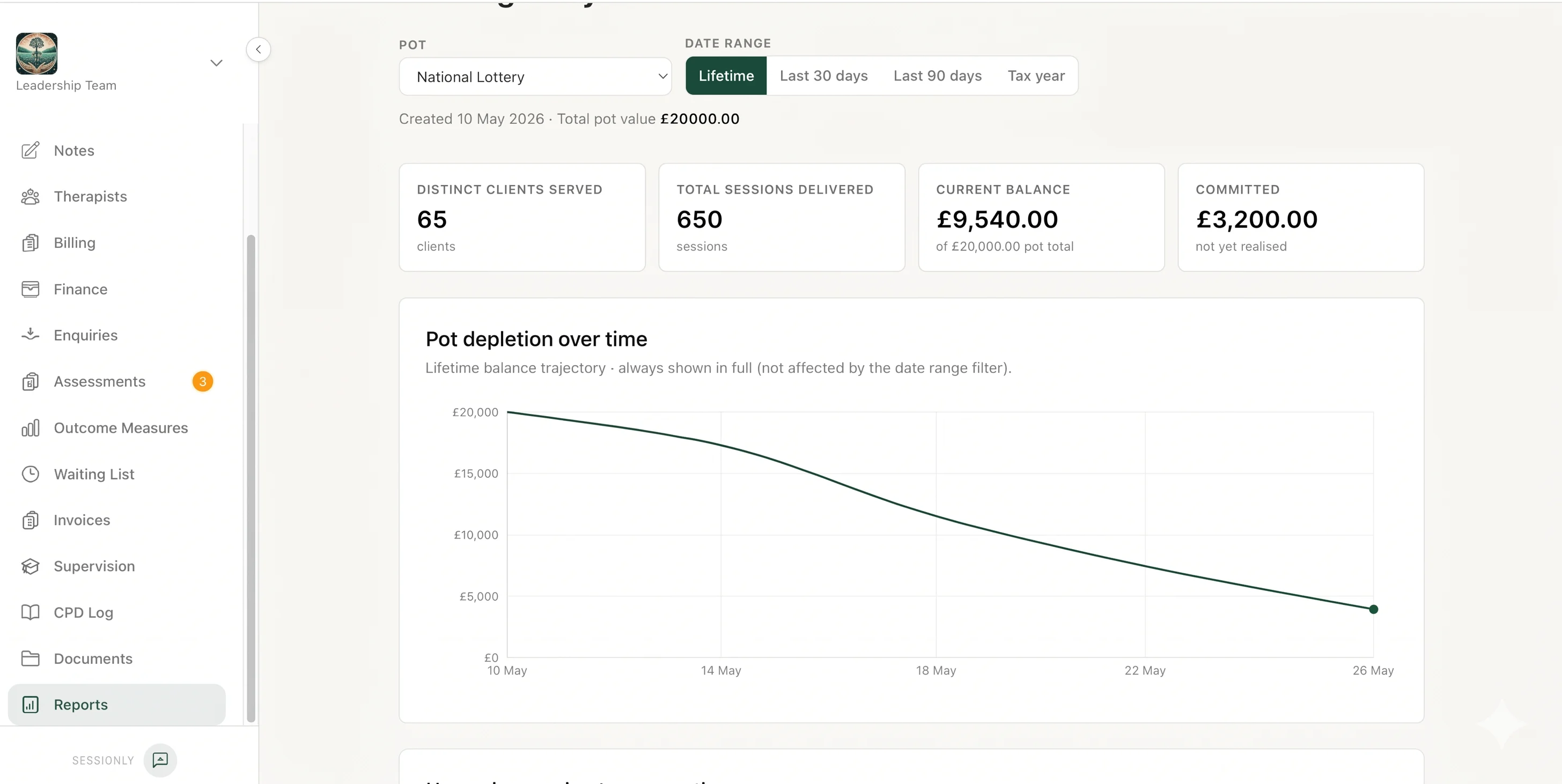
Every grant, commissioned contract or third-party block booking lives in Sessionly as its own funding pot. Each pot has its own amount, start and end dates, and reporting period. As sessions are delivered and expenses tagged, Sessionly draws the pot down in real time — so the live balance and spend to date are always available, not a year-end calculation.

Client cost splits

A single session can be split between the client's share and one or more funding pots. The client's invoice shows only their portion. Each pot draws down independently for the portion it covers.

Expense tagging

Supervision, CPD, training and other overheads can be tagged against a funding pot on the finance page — so a grant that earmarks money for clinical supervision draws down for supervision the same way it does for client sessions.

Third-party block bookings

When an EAP, local authority or other referrer pays up front for a block, the block is set up as a pot. Sessions delivered against that referrer draw down; remaining capacity stays visible on the pot itself.

See funding pots and demographic reporting in more depth →

Demographic reports, filtered by pot

Every client record can capture age, date of birth, location, gender, ethnicity, employment status, sexual orientation, disability, referral source and previous therapy history — all optional fields, all at the client level. Reports → Demographics then filters those breakdowns by any funding pot, so a report on a specific grant or contract shows the demographic picture of the people that particular pot reached.

Reports render as visual breakdowns — bar charts by dimension — and can be exported to include in commissioner reports and grant returns.

Sessionly funding analytics dashboard showing spend tracking across multiple funding pots for a UK counselling CIC

Clinical governance

A two-code system for CIC clinical safeguarding

For counselling CICs handling sensitive work — safeguarding referrals, community counselling for vulnerable groups, historical trauma work — Sessionly's two-code system puts a layer of pseudonymisation between administrative and clinical records. Choose it at signup and it is set permanently for the organisation, so it is worth Leadership Teams talking through before committing.

Clinical Record Code

A human-created code assigned at the point of enquiry. Used in administrative contexts only — client lists, assessments, waiting lists, therapist management.

Visible in: /clients, assessments, waiting list

Anonymous Code

A system-generated code assigned when a client is allocated to ongoing therapy. Used in clinical contexts only — session notes, process notes, outcome measures.

Visible in: /notes, outcome measures

The single bridge: Secure Code Lookup

Only Leadership Team members can look up which Anonymous Code belongs to which Clinical Record Code, and every single lookup is written to the audit trail with user, timestamp and IP. It is the only place in Sessionly where the two codes appear together — so even if administrative records were ever disclosed, the clinical record on the other side stays behind genuine pseudonymisation.

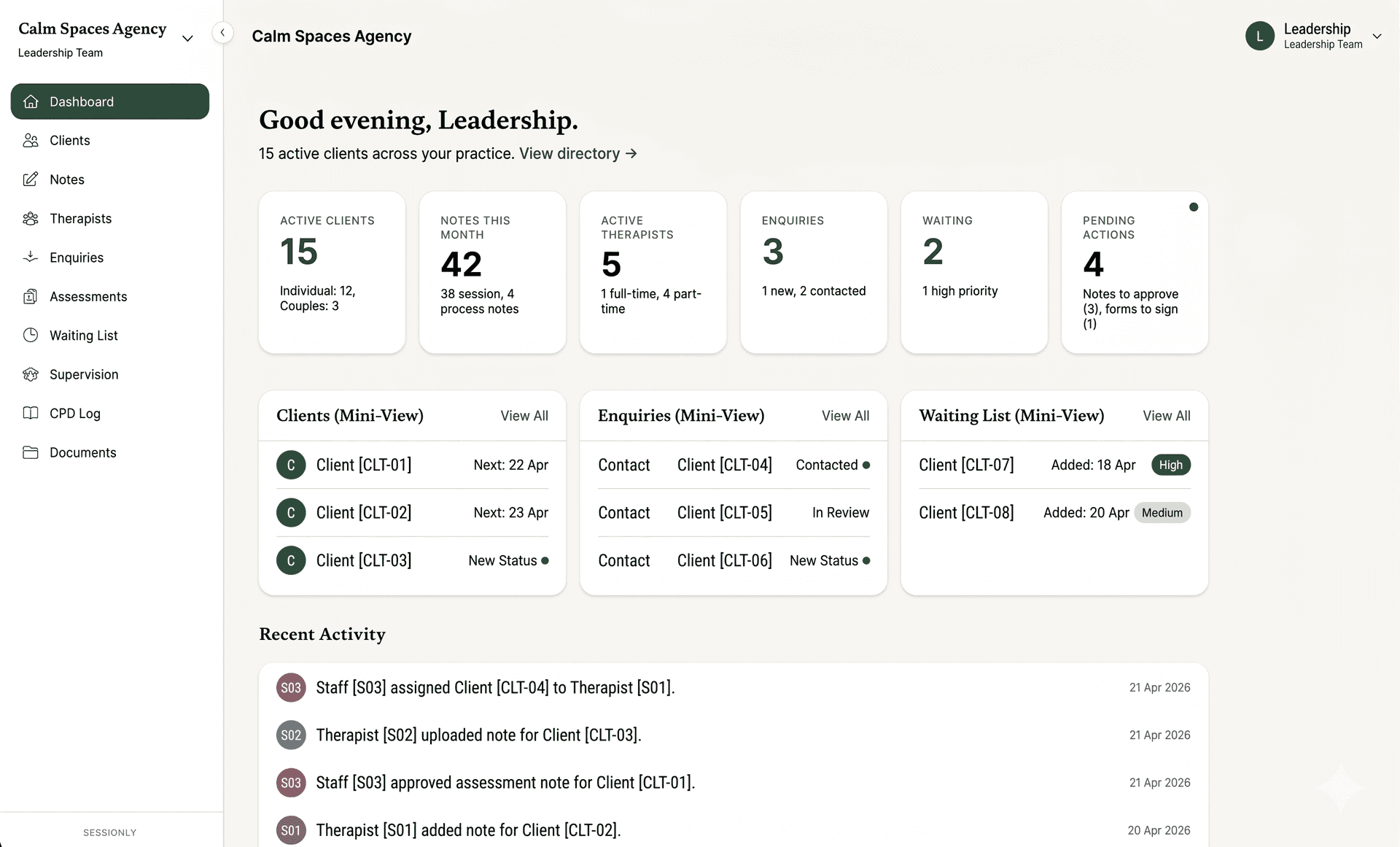
Leadership Team dashboard for CIC oversight

The Leadership Team dashboard gives service leads and directors organisation-wide visibility without stepping into individual therapists' clinical space.

  • Active clients, sessions this month, caseloads per therapist — in a single view
  • Per-client outcome measure compliance — see who is overdue before a funder asks
  • Risk-flag alerts — CORE-10 item 6 and PHQ-9 item 9 scores are surfaced when they cross clinical thresholds
  • Waiting list — see who is waiting, how long, and manage allocation
  • Live activity feed — notes written, assessments submitted, clients reassigned
Leadership Team dashboard in Sessionly showing organisation-wide oversight of therapists, clients and outcome measure compliance for a UK counselling CIC
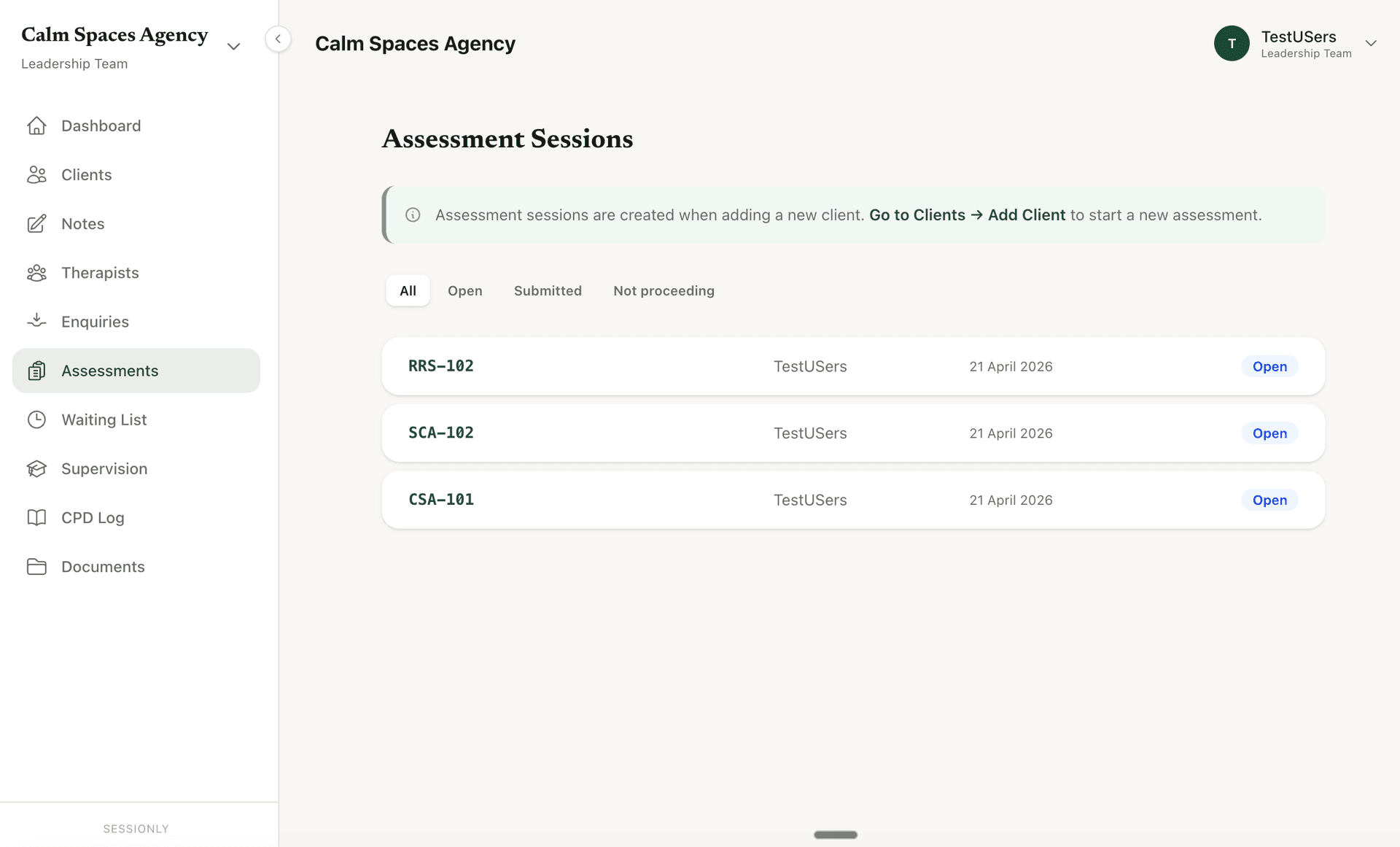
Sessionly assessment sessions view showing intake assessments, assigned assessors, and outcome statuses for a UK counselling CIC

Outcome measures across the whole service

Sessionly supports PHQ-9, GAD-7, CORE-10, CORE-OM, YP-CORE, DES-II, WSAS and Goal-Based Outcomes. Each measure can be set as Required, Recommended or Optional for your organisation — so every therapist follows the same protocol without being chased.

Scoring runs server-side with severity bands. Where a measure has a clinically defined risk item — CORE-10 item 6, PHQ-9 item 9 — a positive response surfaces to the Leadership Team dashboard automatically.

Licensing note

CORE-10 requires acknowledgement of CORE System Trust's CC BY-NC-ND licensing terms.

Note governance and data protection built in

Counselling CICs carry the same clinical record-keeping duties as any other counselling service, on top of community accountability. Sessionly builds record governance in at the platform layer.

Notes cannot be deleted by therapists

Deletion requests go to a Leadership Team approval queue. Request, reason and decision are all recorded.

Every edit creates a version snapshot

Full version history on every note — what was written, when, by whom, including the original before any edits.

Client reassignment preserves history

When a client moves between therapists, the full note history transfers with clear attribution — nothing is lost, nothing is ambiguous.

UK/EU hosting and AES-256-GCM encryption

Data hosted in the UK/EU. Direct identifiers — client names and contact details — are stored with AES-256-GCM encryption. Full audit trail on every view, edit, export and code lookup.

£49.99/month for the whole service

Or £499/year — save 17%. Up to 25 therapists. No per-seat charges. Adding a volunteer or sessional counsellor does not change the bill.

14-day free trial. No credit card required.

See full pricing →

What is practice management software for a UK counselling CIC?

Practice management software for a UK counselling CIC is the day-to-day system a Community Interest Company uses to run a counselling service end-to-end: taking enquiries, managing a waiting list, allocating clients to therapists, writing session notes, tracking outcome measures, booking sessions on a calendar and invoicing. What distinguishes it from the private-practice equivalent is that a CIC does not sit inside a single billing model. Clients come funded by grants, covered by commissioned contracts, on sliding-scale contributions, or via referrer blocks bought by an EAP or local authority — often in the same case-load, sometimes on the same client. The software has to hold that mix without turning every month-end into a reconciliation exercise.

In Sessionly's case, that shape is expressed through funding pots (one per grant, contract or referrer block), split-payment sessions (a single session can be part client, part pot, or split across several pots), expense tagging (supervision, CPD and other overheads draw down against the pot they belong to) and demographic reporting that filters by pot — so a report on a specific fund shows the people that fund reached, broken down by age, location, gender, ethnicity, employment status, sexual orientation, disability, referral source and previous therapy history.

Sitting alongside the funding side is the governance side that any counselling service running with a team has to take seriously. Sessionly ships a Leadership Team dashboard for organisation-wide oversight, a two-code system that keeps administrative identifiers separate from clinical ones (with the bridge between them audit-logged and Leadership Team only), a note deletion approval queue, full version history on every note, and a complete audit trail on every view, edit and export. Data is UK/EU hosted; direct identifiers are stored with AES-256-GCM encryption.

Pricing is flat: £49.99/month or £499/year for up to 25 therapists, with no per-seat charges. This matters for CICs particularly, because it means adding a volunteer or sessional counsellor to the service does not change the software bill.

Counselling services choosing Sessionly

As a growing counselling service, we needed something that was intuitive, professional and easy for both our team and our clients to use. Sessionly has simplified everything from client onboarding and appointments to outcome measures and communication, allowing us to spend less time on administration and more time supporting people. The team are also incredibly responsive and genuinely listen to feedback, which makes it feel like a platform that's evolving alongside the needs of its users.
GG
Gail Goldspink
I tried a lot of systems before moving over to Sessionly, and most of them felt overly complicated or clearly not designed with therapists in mind. Sessionly just made sense straight away — genuinely easy to set up and start using without hours of figuring things out. Mark has been really approachable and responsive whenever I've had questions or feedback, and you can tell the system has been built by people who actually understand private practice and how therapists work day-to-day.
KA
Kerry Alleyne

Frequently asked questions

Is Sessionly suitable for a UK counselling CIC?

Yes. Sessionly is built for UK counselling CICs, community counselling charities and any counselling service delivering a mix of funded, subsidised and self-pay work. It brings the standard practice management stack — clients, waiting lists, session notes, outcome measures, calendar and invoicing — together with funding pots, split-payment sessions, third-party block booking tracking and demographic reporting broken down by pot.

How is this different from the /agencies page or the funding-and-demographic-reporting page?

This page is the CIC-org-type view: everything a counselling CIC uses Sessionly for, in one place. The /agencies page covers the full team-management feature set for any counselling agency. The funding-and-demographic-reporting-for-therapy-cics page goes deeper on the funding-pot and demographic-report mechanics themselves. All three describe the same product — the split is about which entry point matches how you searched.

Does Sessionly replace our accounting software?

No. Sessionly is practice management, not statutory accounts. It tracks funding pots inside your practice — pot balances, what's been drawn down, what a session or expense was tagged against, and demographic breakdowns for the people each pot reached. Your accountant or accounting software still handles year-end filings and statutory accounts.

Can a single session be split across a client and multiple pots?

Yes. A single session can be split between the client's share and one or more funding pots. The client's invoice shows only what they owe. Each pot draws down independently for the portion it covers, which is what makes sliding-scale and mixed-funded work fit inside the same billing flow as full-fee work.

What demographic data does Sessionly capture for CIC reporting?

Age, date of birth, location, gender, ethnicity, employment status, sexual orientation, disability, referral source and previous therapy history. All optional at the client level. Reports → Demographics can filter these by funding pot and produce visual breakdowns to export.

Can we track EAP and other third-party block bookings?

Yes. When an EAP, local authority or other referrer pays up front for a block of sessions, set the block up as a funding pot. As sessions are delivered against the referrer, the pot draws down. Remaining capacity is visible on the pot itself, which is how you know when to invoice the next block.

Does the two-code system apply to CIC clinical work?

It is available to any organisation and is worth choosing at signup for CICs handling sensitive work. Every client gets a Clinical Record Code (used in admin contexts — client lists, assessments, waiting lists) and an Anonymous Code (used in clinical contexts — session notes, process notes, outcome measures). The two codes never appear on the same screen; the Secure Code Lookup in Settings is the only bridge, is Leadership Team only, and every lookup is written to the audit trail.

Which outcome measures are supported?

PHQ-9, GAD-7, CORE-10, CORE-OM, YP-CORE, DES-II, WSAS and Goal-Based Outcomes. Each is scored server-side with severity bands and risk flags where clinically defined (CORE-10 item 6 and PHQ-9 item 9). Every measure can be set as Required, Recommended or Optional for your organisation, so every therapist follows the same protocol.

Do you support volunteer and sessional counsellors?

Yes. Pricing is flat: £49.99/month (or £499/year) covers up to 25 therapists. Adding a volunteer or sessional counsellor does not change the bill. Each therapist gets their own login, their own clients and their own calendar, with the Leadership Team retaining oversight across the whole service.

How is client and clinical data protected?

Data is UK/EU hosted. Direct identifiers (client names and contact details) are stored with AES-256-GCM encryption. Note edits produce version snapshots; note deletions go to a Leadership Team approval queue rather than happening in place. Every view, edit, export and code lookup is written to the audit trail with timestamp, user and IP.

Is there a free trial?

Yes. 14 days, no credit card required. The whole feature set — funding pots, demographic reporting, two-code governance, outcome measures, calendar, invoicing, everything — is available in the trial.
Start your 14-day free trial

No credit card required. Up to 25 therapists. £49.99/month.